Why a cooler object really can warm a warmer one – and how it all works.
Posted on 28 June 2023 by Bob Loblaw
Introduction: Not the Greenhouse Effect – but Just as Important
Yes, you read that right. We’re talking about the Green Plate Effect – not the Greenhouse Effect, but a brilliant analogy that cuts through one of climate denial’s most stubborn myths.
First introduced by blogger Eli Rabett back in 2017, the Green Plate Effect tackles a claim that refuses to die: “A colder object can never make a warmer object hotter – that would violate the Second Law of Thermodynamics.” This argument is often used to dismiss the greenhouse effect, on the grounds that the atmosphere (colder than the surface) cannot possibly add heat to the surface.
Eli’s response? “They neglect the fact that heating and cooling are dynamic processes, and thermodynamics is not static.”
Skeptical Science has linked to Eli’s original post since 2017, yet even now, commenters on our Second Law thread keep repeating the same tired objection. So we’ve decided to provide a self-contained summary here – plus something Eli didn’t show: the actual time evolution of the Green Plate Effect, from start to equilibrium.
Note: Reading Eli’s or
iginal is still well worth your time – it’s more complete in derivation. Bu
t if you want the dynamic version, sti
ck with us. (And yes, put on your he
ad vice before diving into the comments.)
The Greenhouse Effect in a Nutshell
In the Earth-atmosphere system:
-
Solar visible light warms the surface with little absorption by the atmosphere.
-
The surface radiates infrared (IR) back upwards.
-
Much of that IR is absorb
-
ed by the atmosphere, n
-
ot lost directly to space.
-
The atmosphere re‑radiates IR in both directions – up and down.
-
The downward IR is absorbed by the surface, re‑emitted, and may cycle several times before escaping.
Net result: the surface ends up warmer than it would be without an atmosphere. And that’s where the denialist objection comes in: “But the atmosphere is colder than the surface – so how can it warm the surface?”
The Green Plate Effect shows exactly how – using nothing more than two flat plates and the Stefan‑Boltzmann law.
The Green Plate Effect – Step by Step
Step 1: The Blue Plate alone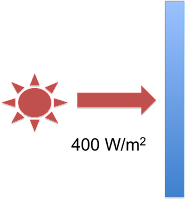
Imagine a single, perfectly absorbing plate (call it the Blue Plate) receiving 400 W/m² of solar radiation on one side. The other side is dark. The plate heats up and emits IR from both sides equally.
At equilibrium, the emitted radiation from both sides must balance the absorbed solar input:
-
Solar input = 400 W/m²
-
Emission from left side + emission from right side = 400 W/m²
-
Since both sides are at the same temperature, each emits 200 W/m².
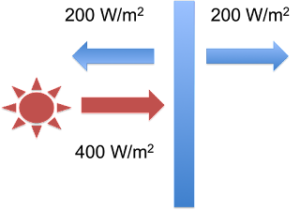
Using the Stefan‑Boltzmann law (E = σT⁴), we get a temperature of 244 K for the Blue Plate. This is Eli’s Figure 2.
Step 2: Enter the Green Plate
Now place a second plate – the Green Plate – to the right of the Blue Plate. It’s completely shaded from the sun. The only energy it receives is the IR emitted from the right side of the Blue Plate.
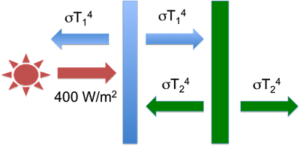
At equilibrium, the energy flows are as follows (Eli’s Figure 5):
-
The Blue Plate still receives 400 W/m
-
² from the sun.
-
It also receives back‑radiation from the Green Plate (which is emitted from the Green Plate’s left side).
-
The Blue Plate emits from both its left and right sides.
-
The Green Plate receives ra
-
diation from the Blue Plate’s right side, and emits from both its own sides (left and right).
With a bit of algebra, Eli found that the new equilibrium temperature of the Blue Plate rises to 262 K – a full 18 K warmer than without the Green Plate. The Green Plate itself settles at 220 K.
Key insight: The Green Plate is colder than the Blue Plate (220 K vs 262 K). Yet its presence increases the Blue Plate’s temperature. The cooler body does affect the warmer body’s radiative balance – and in a way that raises the warmer body’s temperature. No violation of the Second Law – just a dynamic energy balance.
The Dynamics – From Zero to Equilibrium
Eli only calculated the equilibrium. But what happens over time? How do the temperatures and fluxes evolve from a cold start?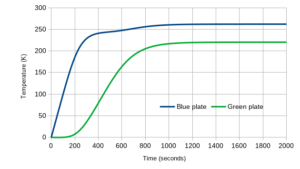
We can model this by adding a simple heat capacity to each plate. Let’s choose a value such that a net input of 400 W/m² raises the temperature by 1 K per second (thin plates, fast response). Then, at any moment:
-
For the whole system:
Net input = 400 – (σT₁⁴ + σT₂⁴) -
For the Blue Plate (T₁):
Net input = 400 + σT₂⁴ – 2σT₁⁴ -
For the Green Plate (T₂):
Net input = σT₁⁴ – 2σT₂⁴
Temperature change per second = Net input / 400.
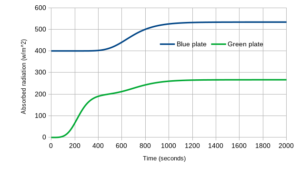
Starting both plates at 0 K, we can simulate the warming in a spreadsheet. The results (see Figure 5 in the original) show:
-
After about 1200 seconds, both plates reach equilibrium at Eli’s predicted temperatures.
-
The Green Plate never becomes w
-
armer than the Blue Plate.
-
Around 300–400
-
seconds, the Blue Plate nearly stabilises near the 244 K (the no‑Green‑Plate value) – because the Green Plate is st
-
ill too cold to radiate much back.
-
As the Green Plate warms, its back‑radiation increases, causing a second warming phase for the Blue Plate, pushing it up to 262 K.
We can also track the absorbed energy for each plate:
-
Initially, the Blue Plate absorbs only the sun’s 400 W/m².
-
The Green Plate starts with zero input.
-
As the Blue Plate warms,
-
it radiates to the Green Plate, which then warms and sends radiation back.
-
At equilibrium, the Blue Plate receives 533 W/m² total (400 from sun + 133 from the Green Plate) – a 33% increase, hence the higher temperature.
-
The Green Plate always absorbs less than the Blue Plate.
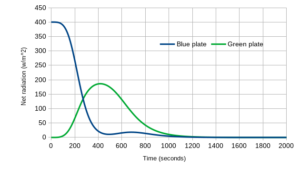
And looking at net radiation (input minus emitted):
-
The Blue Plate starts with a net +400 W/m², dropping to zero as it warms.
-
The Green Plate initially has zero net, then positive as it receives more from the Blue P
-
late, then back to zero at equilibrium.
So What Does This Teach Us?
The Green Plate Effect is a beautiful, simple demonstration that:
-
A cooler object can indeed raise the equilibrium temperature of a warmer object – by altering the radiative environment.
-
This does not violate the Second Law of Thermodynamics; it’s a consequence of energy conservation and dynamic equilibrium.
-
The analogy to the greenhouse effect is direct: the atmosphere (like the Green Plate) absorbs IR from the surface (the Blue Plate), re‑emits some back downward, and that extra energy input raises the surface temperature above what it w
-
ould be without the atmosphere.
In Eli’s own words (paraphrased):
“The presence of a cooler body changes the radiative balance of a warmer body, and because the warmer body must emit more to balance its total inputs, its temperature rises. That’s not magic – it’s physics.”
Final Thought
Next time someone tells you that “a colder atmosphere can’t warm the surface because of the Second Law,” point them to the Green Plate Effect. Two plates, simple algebra, and a spreadsheet – that’s all it takes to show that the objection is built on a misunderstanding of thermodynamics. The atmosphere doesn’t violate the laws of physics; it just plays by a more subtle set of rules.
And if you want to see the actual numbers unfold over time, you now have them. The Green Plate Effect isn’t just a thought experiment – it’s a dynamic reality.
Enjoyed this? Check out Eli’s original post for the full derivation, and feel free to leave your questions or comments below. Let’s keep the discussion constructive – and the physics accurate.